
Nationwide WastewaterSCAN December 2025 Update
Happy New Year Everyone!
This newsletter contains updates on the WastewaterSCAN program with wastewater samples analyzed by the lab through December 31, 2025. Below you will find information on the program in terms of participating partners, review of targets being measured, as well as current wastewater categories (low, medium, high) of the infectious disease targets.
Best,
WastewaterSCAN Team
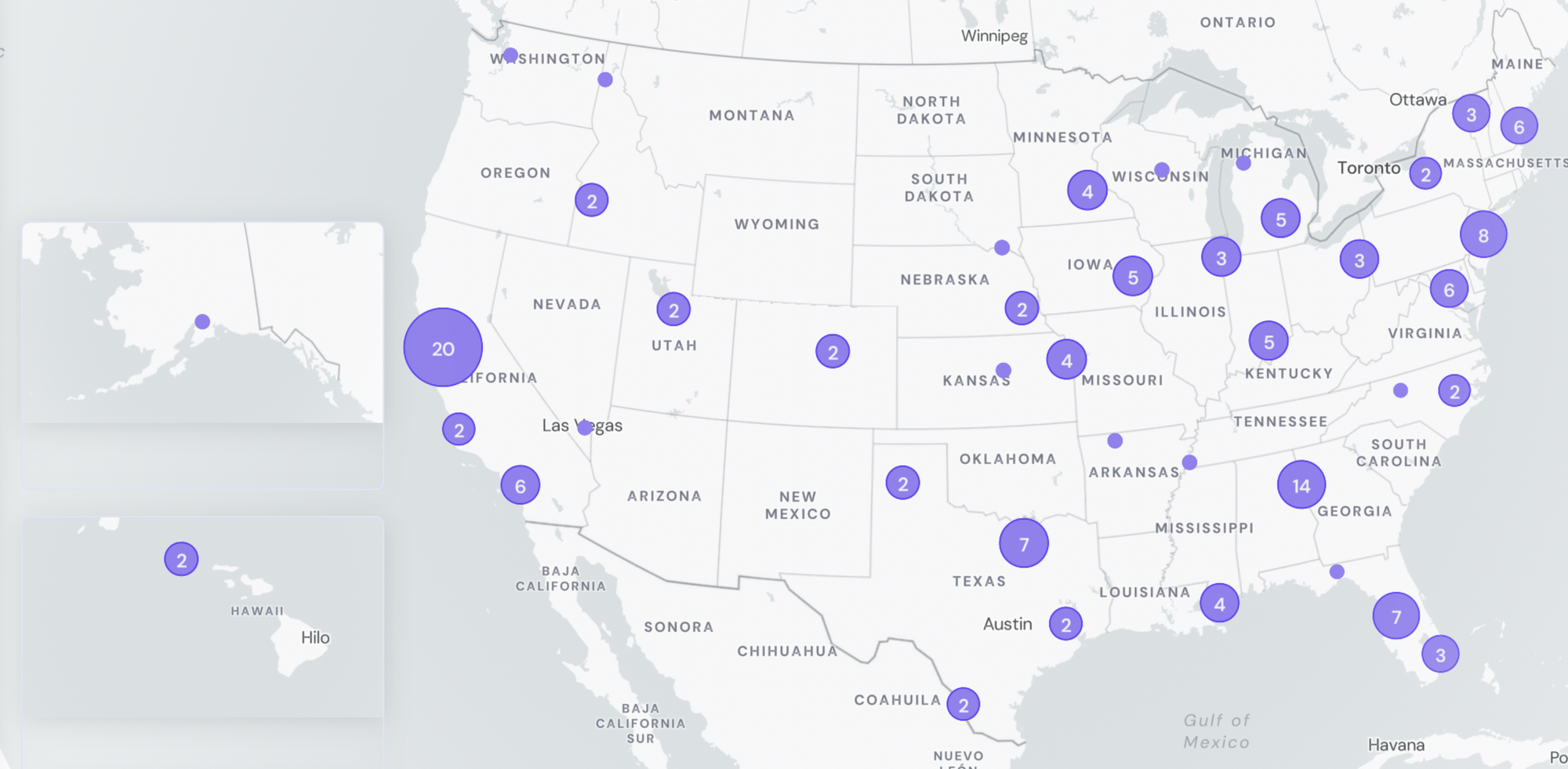
Participating Plants
147 WWTPs plants across 40 states
WWSCAN Participant Stats:
- 147 plants sampling
- >37 million people covered through sampling efforts
- 40 states
Infectious Disease Target Review
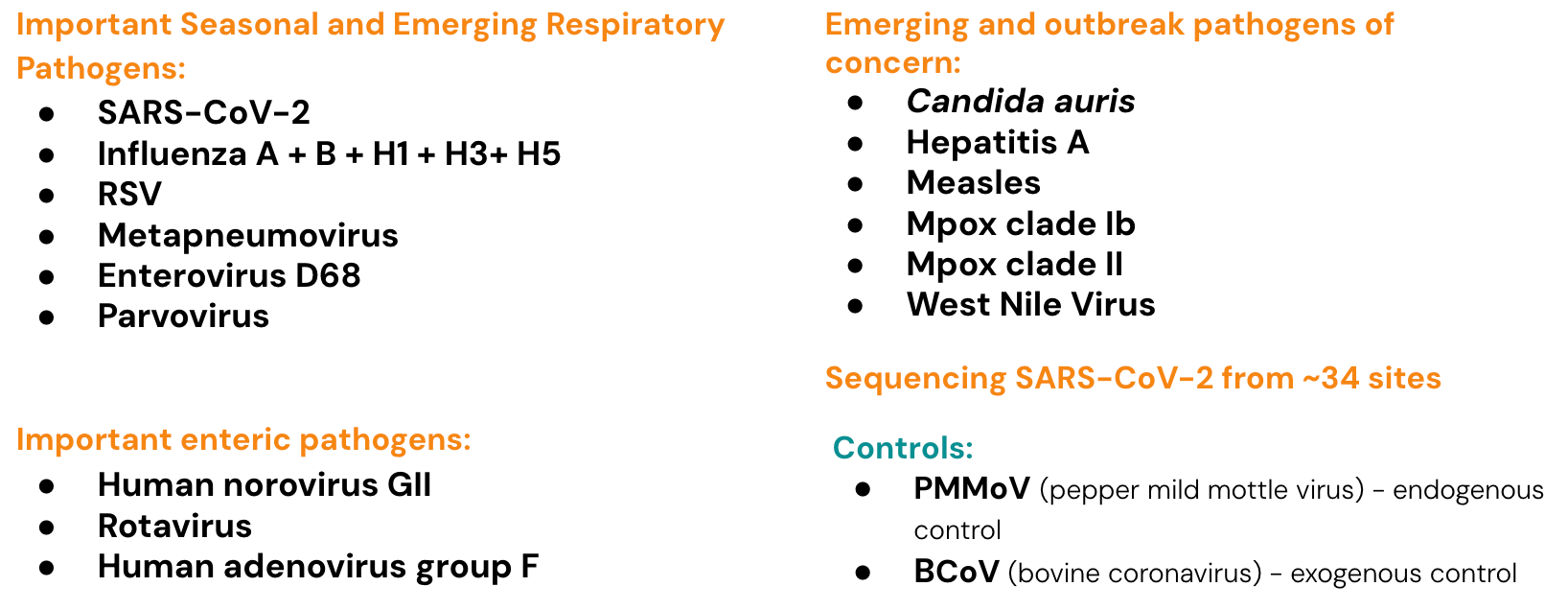
Currently monitoring a suite of Respiratory, Gastrointestinal and Outbreak Pathogens of Concern
The methods for our assays are in the public domain and links for these are provided at the end of the newsletter. West Nile Virus was added to the pathogen panel WWSCAN monitors for in mid-October 2025. As a reminder, in mid-May 2025 WWSCAN resumed measurements of Rotavirus and Adenovirus group F, and added Measles (wild-type) and Parvovirus to the list of pathogens monitored.
Program Publications
Recent publications, factsheets, FAQs, and more!
WWSCAN Published Body of Work document:
- We are excited to share a document that provides an overview of the program’s peer-reviewed scientific literature, organized by topics and themes. Click here to access the WastewaterSCAN published body of work.
WWSCAN FAQs:
- Frequently Asked Questions on Measurements of Candida auris (C. auris) in Wastewater Solids
- Frequently Asked Questions on WWSCAN Measurements of H5 Marker in Wastewater Solids
- Frequently Asked Questions on WWSCAN Measurements of Hepatitis A Virus (HAV) RNA in Wastewater Solids
- Frequently Asked Questions on WWSCAN Measurements of Measles RNA in Wastewater Solids
- Frequently Asked Questions on WWSCAN Measurements of Mpox clade Ib in Wastewater Solids
- Frequently Asked Questions on WWSCAN Measurements of West Nile Virus in Wastewater Solids
WWSCAN Factsheets and Guidance Documents can be found here.
Wastewater Category Logic
As a reminder, WWSCAN's categorize sites based on Levels + Trends + Frequency of detection. We adopted this methodology back in 2023 as a way to clearly communicate what wastewater is telling us about community disease circulation. The wastewater categorization helps us quickly understand if the recent measurements for a disease fall into a low, medium, or high category and are determined based on a combination of the following variables:
- Trends tell us how concentrations are changing (↑, ↓, -) over the last 21 days
- Levels tell us whether concentrations are relatively lower or higher (based on national tertiles over last 365 days)
- Frequency of detection indicates how often a pathogen is detected in wastewater (important for pathogens that are not commonly detected)
There are 3 Archetypes for WWSCAN Pathogens:
- Pathogens that are commonly detected (regardless of season - includes SARS-CoV-2, Norovirus)
- Seasonal pathogens (rarely detected outside of season/outbreaks - includes Influenza A + B, RSV, HMPV, EV-D68)
- Pathogens that are not commonly detected (regardless of season - includes C. auris, HepA, Measles, Mpox clade Ib, Mpox clade II, West Nile Virus)
*Categories are not being calculated for H1/H3/H5 Influenza markers, Parvovirus, Rotavirus or Adenovirus Group F.
To learn more about WWSCAN's categorization logic, please see: https://data.wastewaterscan.org/about/#8
COVID-19
SARS-CoV-2 concentration in wastewater and sequencing for variants
SARS-CoV-2 N gene RNA was detected in ~88% of samples in December 2025. The median SARS-CoV-2 concentration across all sites in December 2025 was 22,531 copies/gram. The median SARS-CoV-2 concentration in December 2025 was up ~82% compared to November 2025. While SARS-CoV-2 concentrations are low in the West, we are seeing elevated concentrations across the Midwest and Northeast regions. We will continue to monitor these trends as we move through the winter months.
Below is the population weighted average SARS-CoV-2 N gene concentrations (normalized by PMMoV) is shown in black from all participating WWSCAN sites across the country over the last 365 days.
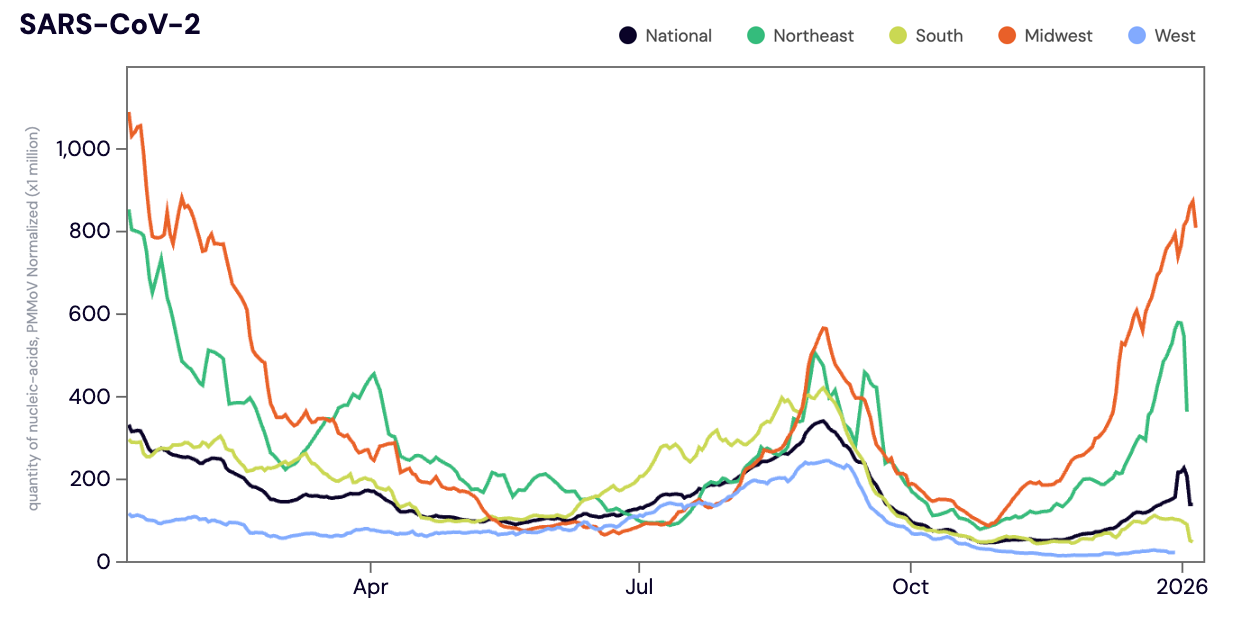
Midwest states: IA, IL, IN, KS, MI, MN, NE, OH, SD, WI. Northeast states: CT, MA, ME, NH, NJ, NY, PA, VT. Southern states: AL, AR, DE, FL, GA, KY, LA, MD, MS, NC, TN, TX, VA, and WV. Western States: AK, CA, CO, HI, ID, NV, UT, WA.
Nationally, SARS-CoV-2 is in the 'HIGH' category with aggregated measurements showing high concentrations and a upward trend over the last 3 weeks.
Below are the current SARS-CoV-2 wastewater categories for all WWSCAN sites (recall the category is determined by both the trend and the level):
- 40 are in the LOW Wastewater Category
- 23 are in the MEDIUM Wastewater Category
- 58 are in the HIGH Wastewater Category
- 26 do not have enough data to calculate
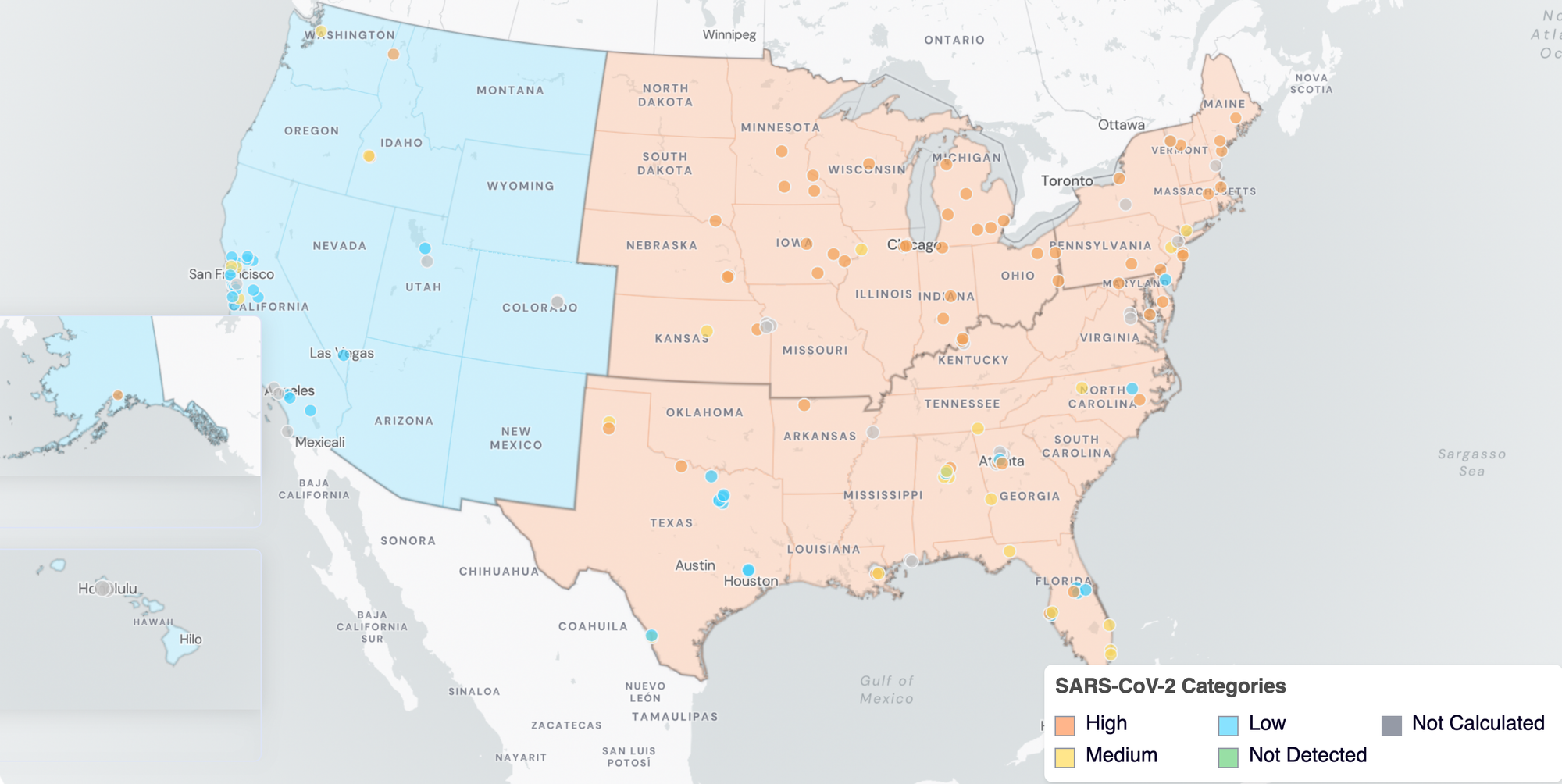
SARS-CoV-2 Wastewater Categories. This map includes sample collection data through December 31, 2025. Each dot represents a single site and the four US Census regions are outlined in gray. Midwest Region includes: IA, IL, IN, KS, MI, MN, NE, OH, SD, WI. Northeast Region includes: CT, MA, ME, NH, NJ, NY, PA, VT. Southern Region includes: AL, AR, DE, FL, GA, KY, LA, MD, MS, NC, TN, TX, VA, and WV. Western Region includes: AK, CA, CO, HI, ID, NV, UT, WA.
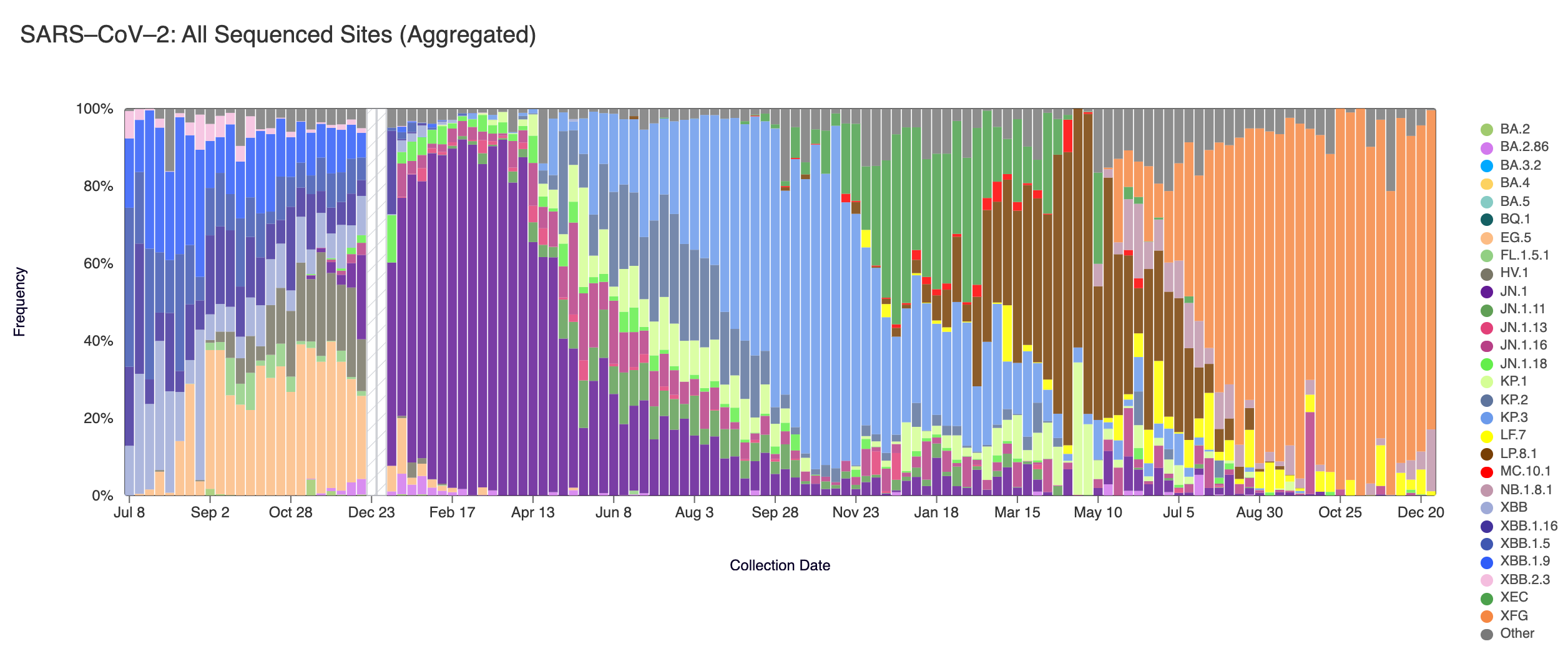
Sequencing of SARS-CoV-2 from wastewater is available for a select number of individual sites. The sequencing protocol is available on protocol.io. The plots below show the relative proportions of different variants inferred from sequencing the entire genome of SARS-CoV-2. Results are based on sequencing of 2 samples per week, combined to provide a weekly value.
Sequencing data is also available in aggregate across all sites in WWSCAN with sequencing data. That plot is shown below and also suggests that XFG (shown in orange) is the most abundant variant across all sites at 82.5% followed by NB.1.8.1 (shown in mauve) at 16%.
Other Respiratory Pathogens
Influenza A & B, Respiratory Syncytial Virus, Human metapneumovirus, EV-D68 & Parvovirus
Influenza A (IAV) RNA was detected in 90% of samples in December 2025. The median IAV RNA concentration across all sites in December 2025 was 24,667 copies/gram. The median IAV concentration in December 2025 was up ~1,000% compared to November 2025. All regions hit the threshold for seasonal onset in mid to late December 2025. As a reminder, during last years respiratory virus season (2024-2025) the WWSCAN network hit seasonal onset for IAV in mid December 2024.
Below is the population weighted average IAV concentrations (normalized by PMMoV) is shown in black from all participating WWSCAN sites across the country over the last 365 days.
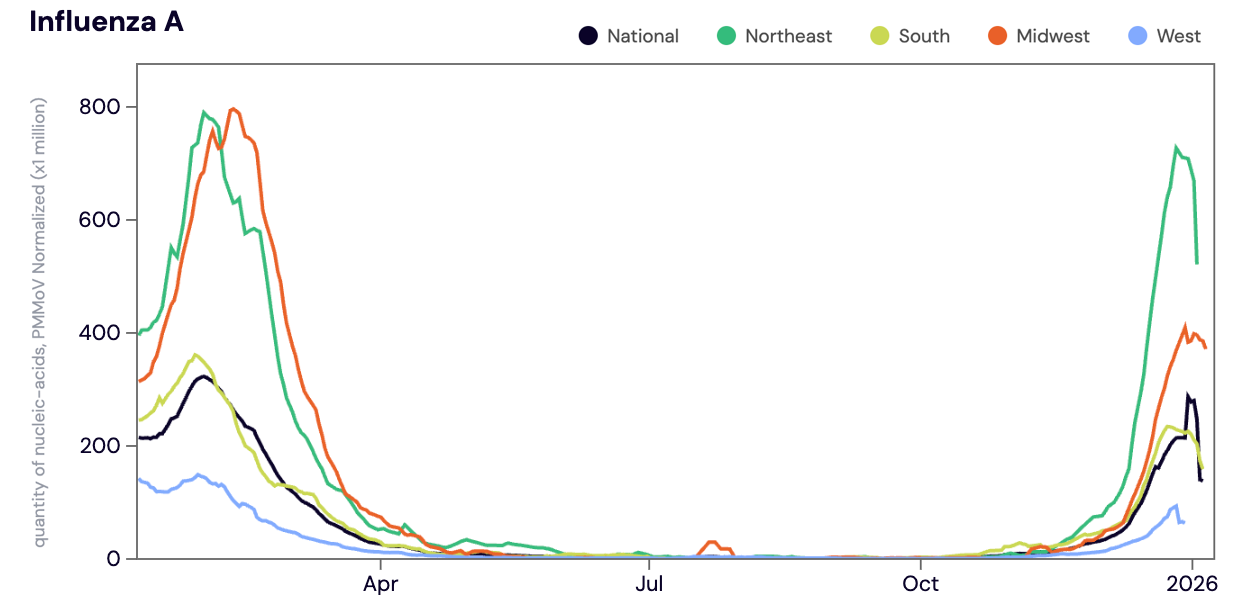
Midwest states: IA, IL, IN, KS, MI, MN, NE, OH, SD, WI. Northeast states: CT, MA, ME, NH, NJ, NY, PA, VT. Southern states: AL, AR, DE, FL, GA, KY, LA, MD, MS, NC, TN, TX, VA, and WV. Western States: AK, CA, CO, HI, ID, NV, UT, WA.
Nationally, Influenza A is in the 'HIGH' Wastewater Category with >50% of sites in seasonal onset for IAV in wastewater. We are seeing high concentrations and an upward trend for IAV in wastewater at the national level.
Below are the current Influenza A wastewater categories for all WWSCAN sites (recall the category is determined by both the trend and the level when in seasonal onset):
- 5 are in the LOW Wastewater Category
- 4 are in the MEDIUM Wastewater Category
- 112 are in the HIGH Wastewater Category
- 26 do not have enough data to calculate
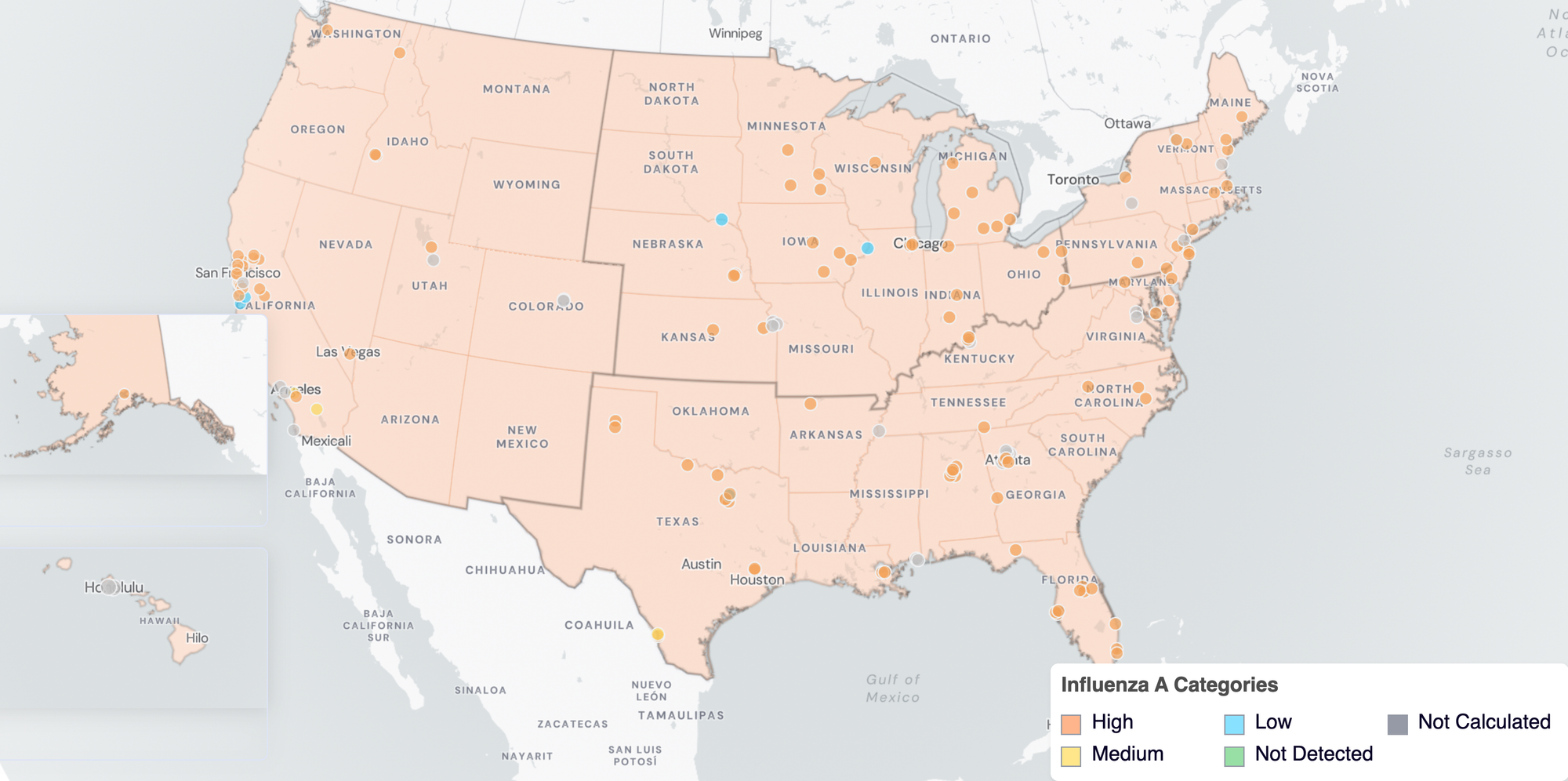
Influenza A Wastewater Categories. This map includes sample collection data through December 31, 2025. Each dot represents a single site and the four US Census regions are outlined in gray. Midwest Region includes: IA, IL, IN, KS, MI, MN, NE, OH, SD, WI. Northeast Region includes: CT, MA, ME, NH, NJ, NY, PA, VT. Southern Region includes: AL, AR, DE, FL, GA, KY, LA, MD, MS, NC, TN, TX, VA, and WV. Western Region includes: AK, CA, CO, HI, ID, NV, UT, WA.
H1 Marker in Influenza A (IAV) The H1 marker in influenza A has been detected in ~31% of samples in December 2025. The H1 median concentration across all sites in December 2025 was below the limit of detection. You can find a heat map of positive H1 detections here.
H3 Marker in Influenza A (IAV) In December 2025, the H3 marker in influenza A was detected in ~83% of samples. The H3 median concentration across all sites in December 2025 was 14,874 copies per gram. At many plants, H3 marker concentrations are increasingly driving the higher influenza A concentrations. A detection of H3 could include subclade K, a highly-mutated H3N2 variant currently spreading worldwide. You can find a heat map of positive H3 detections here.
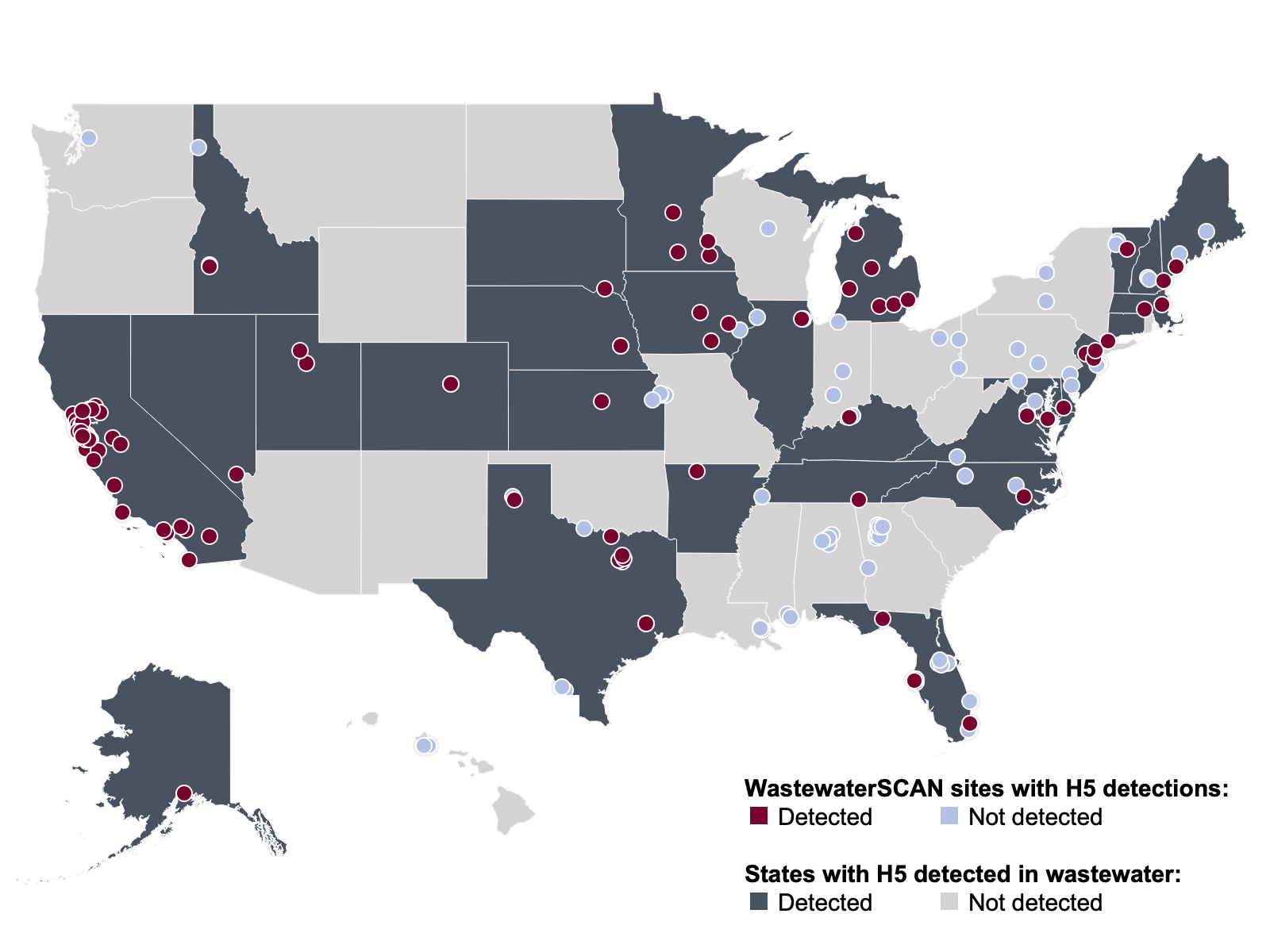
H5 Marker in Influenza A (IAV) As of December 31, 2025, WWSCAN sites across 28 states (AK, AR, CA, CO, CT, DE, FL, IA, ID, IL, KS, KY, MA, ME, MD, MI, MN, NC, NE, NH, NJ, NV, SD, TN, TX, UT, VA and VT) have seen positive detections for the H5 marker in influenza A. Since prospective monitoring began, 1,040/37,961 samples have tested positive (~2.7% detection rate). In December 2025, there were 4 positive H5 marker detection. You can find a heat map of positive detections here.
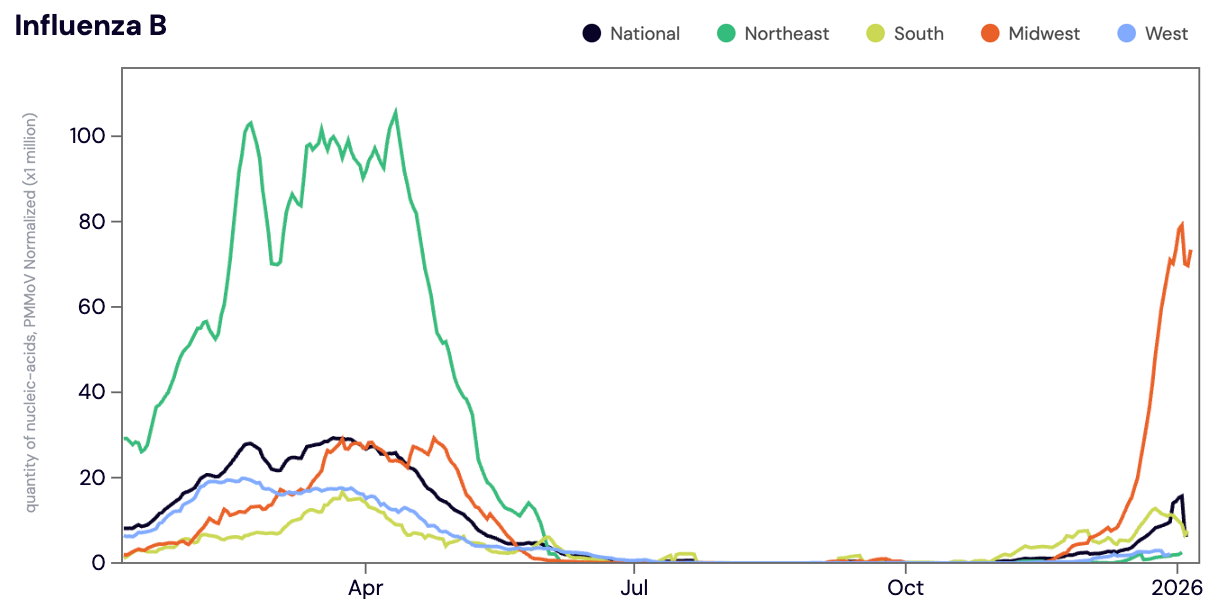
Influenza B (IBV) RNA was detected in ~23% of samples in December 2025. IBV RNA median concentration across all sites in December 2025 was below the limit of detection. Concentrations of IBV have steadily been increasing in sites across the Midwest. As a reminder, during last years respiratory virus season (2024-2025) the WWSCAN network did not hit seasonal onset for IBV until early March 2025.
Below is the population-weighted average IBV RNA concentrations (normalized by PMMoV) is shown in black from all participating WWSCAN sites across the country over the last 365 days.
Midwest states: IA, IL, IN, KS, MI, MN, NE, OH, SD, WI. Northeast states: CT, MA, ME, NH, NJ, NY, PA, VT. Southern states: AL, AR, DE, FL, GA, KY, LA, MD, MS, NC, TN, TX, VA, and WV. Western States: AK, CA, CO, HI, ID, NV, UT, WA.
Nationally, Influenza B is in the 'LOW' Wastewater Category due to >50% of sites being in offset for IBV in wastewater.
Below are the current Influenza B wastewater categories for all WWSCAN sites (recall the category is determined by both the trend and the level when in seasonal onset):
- 100 are in the LOW Wastewater Category
- 0 are in the MEDIUM Wastewater Category
- 21 are in the HIGH Wastewater Category
- 26 do not have enough data to calculate
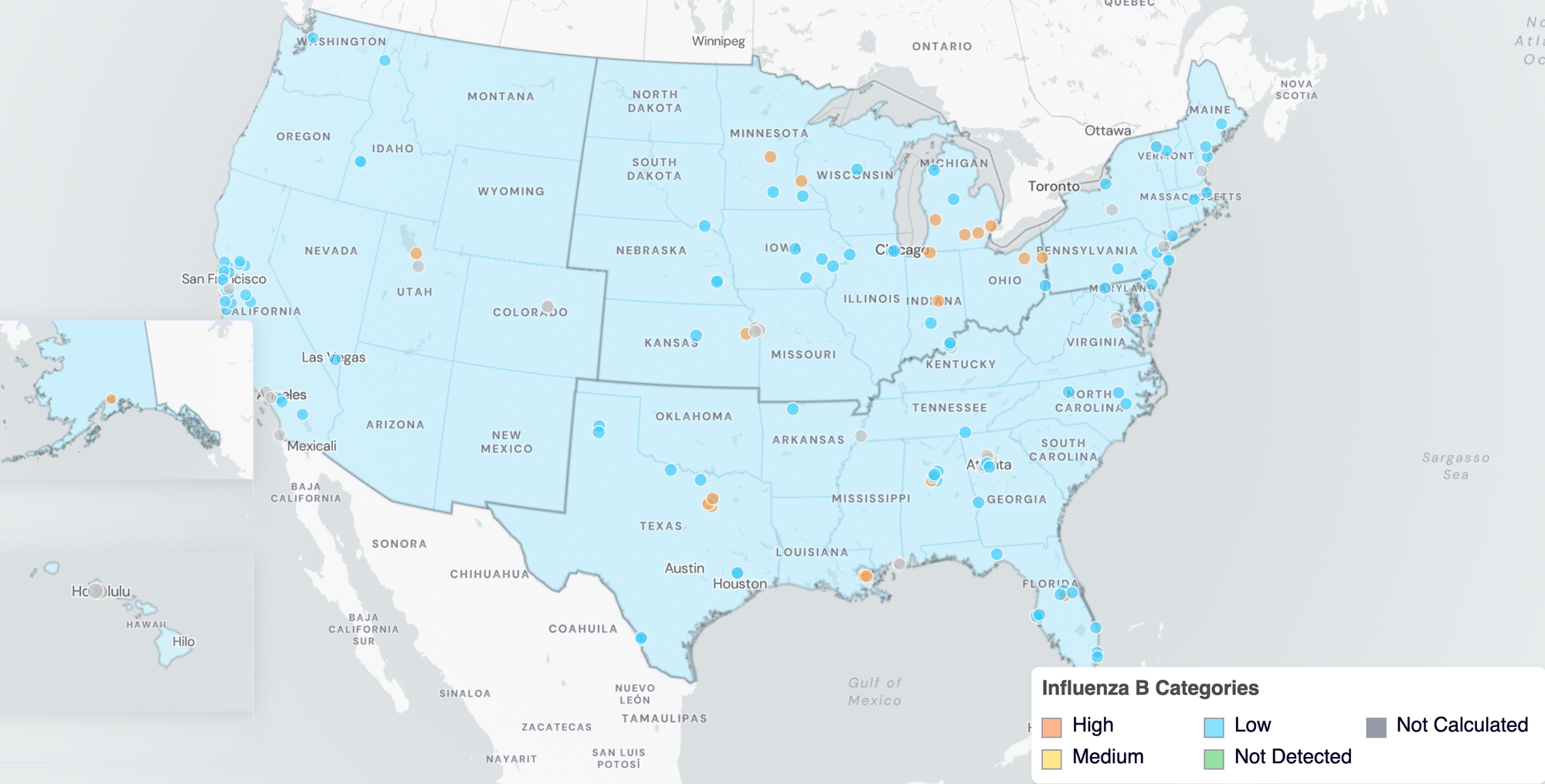
IBV Wastewater Categories. This map includes sample collection data through December 31, 2025. Each dot represents a single site and the four US Census regions are outlined in gray. Midwest Region includes: IA, IL, IN, KS, MI, MN, NE, OH, SD, WI. Northeast Region includes: CT, MA, ME, NH, NJ, NY, PA, VT. Southern Region includes: AL, AR, DE, FL, GA, KY, LA, MD, MS, NC, TN, TX, VA, and WV. Western Region includes: AK, CA, CO, HI, ID, NV, UT, WA.
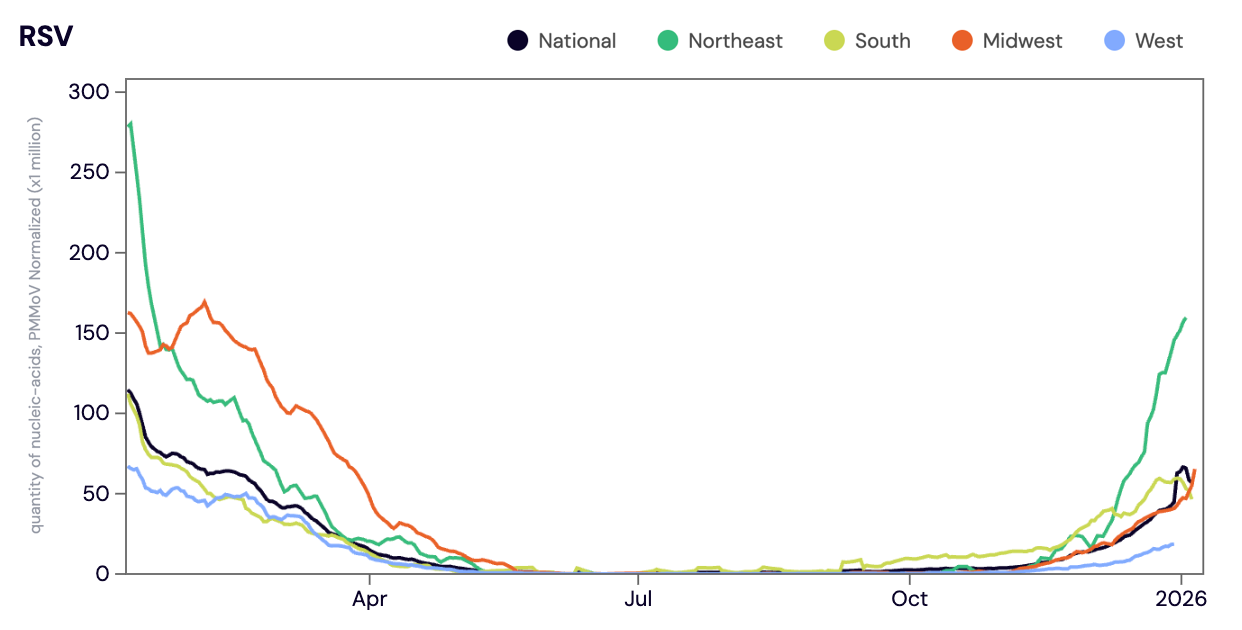
Respiratory syncytial virus (RSV) RNA was detected in ~69% of samples in December 2025. The RSV RNA median concentration across all sites in December 2025 was 7,148 copies per gram. As a reminder, during last years respiratory virus season the WWSCAN network hit seasonal onset for RSV in early December 2024 and peaked in early January 2025. We are currently seeing a slower start to the RSV wastewater wave this year (2025-2026) compared to last year (2024-2025).
Below the population-weighted average RSV RNA concentrations (normalized by PMMoV) is shown in black from all participating WWSCAN sites across the country over the last 365 days. Current RSV concentrations across all regions are still lower compared to where they were this time last year's RSV wastewater wave, but are steadily increasing.
Midwest states: IA, IL, IN, KS, MI, MN, NE, OH, SD, WI. Northeast states: CT, MA, ME, NH, NJ, NY, PA, VT. Southern states: AL, AR, DE, FL, GA, KY, LA, MD, MS, NC, TN, TX, VA, and WV. Western States: AK, CA, CO, HI, ID, NV, UT, WA.
Nationally, RSV is in the 'HIGH' Wastewater Category with >50% of sites in seasonal onset for RSV in wastewater. We are seeing high concentrations and an upward trend for RSV in wastewater at the national level.
Below are the current RSV wastewater categories for all WWSCAN sites (recall the category is determined by both the trend and the level when in seasonal onset):
- 38 are in the LOW Wastewater Category
- 6 are in the MEDIUM Wastewater Category
- 77 are in the HIGH Wastewater Category
- 26 do not have enough data to calculate
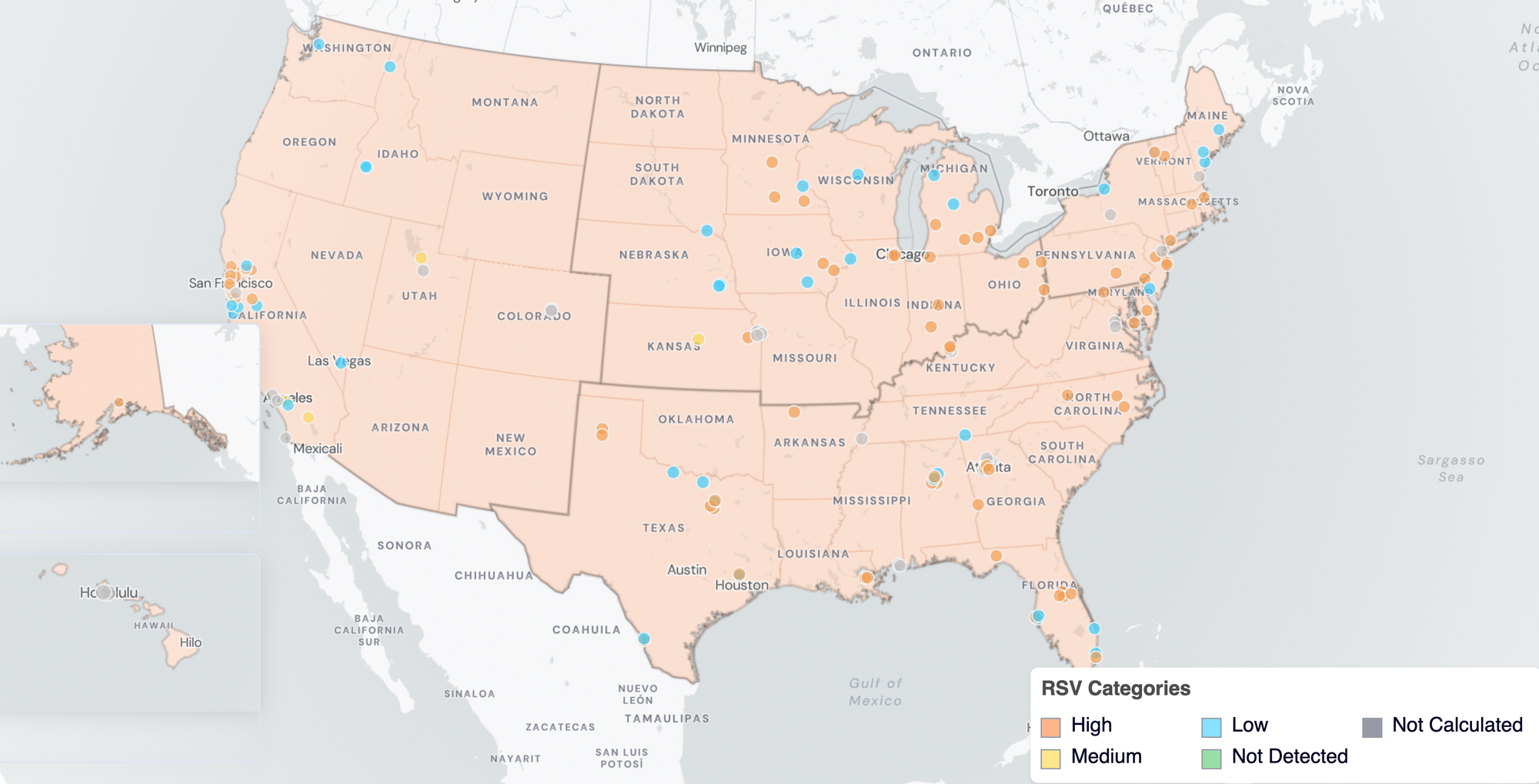
RSV Wastewater Categories. This map includes sample collection data through December 31, 2025. Each dot represents a single site and the four US Census regions are outlined in gray. Midwest Region includes: IA, IL, IN, KS, MI, MN, NE, OH, SD, WI. Northeast Region includes: CT, MA, ME, NH, NJ, NY, PA, VT. Southern Region includes: AL, AR, DE, FL, GA, KY, LA, MD, MS, NC, TN, TX, VA, and WV. Western Region includes: AK, CA, CO, HI, ID, NV, UT, WA.
HMPV (human metapneumovirus) RNA was detected in ~42% of samples in December 2025. The median HMPV RNA concentrations across all sites in December 2025 was below the limit of detection. HMPV concentrations have been steadily increasing across all regions since late December 2025.
Below is the population weighted average HMPV RNA concentrations (normalized by PMMoV) shown in black from all participating WWSCAN sites across the country over the last 365 days.
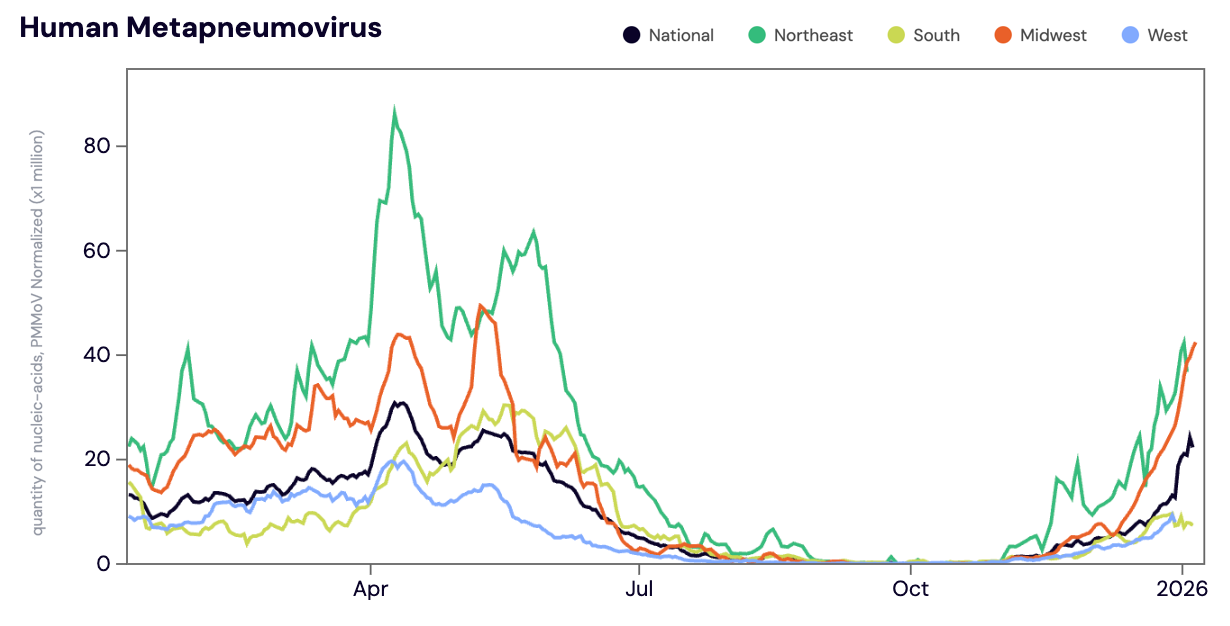
Midwest states: IA, IL, IN, KS, MI, MN, NE, OH, SD, WI. Northeast states: CT, MA, ME, NH, NJ, NY, PA, VT. Southern states: AL, AR, DE, FL, GA, KY, LA, MD, MS, NC, TN, TX, VA, and WV. Western States: AK, CA, CO, HI, ID, NV, UT, WA.
Nationally, HMPV is in the 'LOW' Wastewater Category with most sites in seasonal offset for HMPV in wastewater.
Below are the current HMPV wastewater categories for all WWSCAN sites (recall the category is determined by both the trend and the level):
- 88 are in the LOW Wastewater Category
- 3 are in the MEDIUM Wastewater Category
- 30 are in the HIGH Wastewater Category
- 26 do not have enough data to calculate
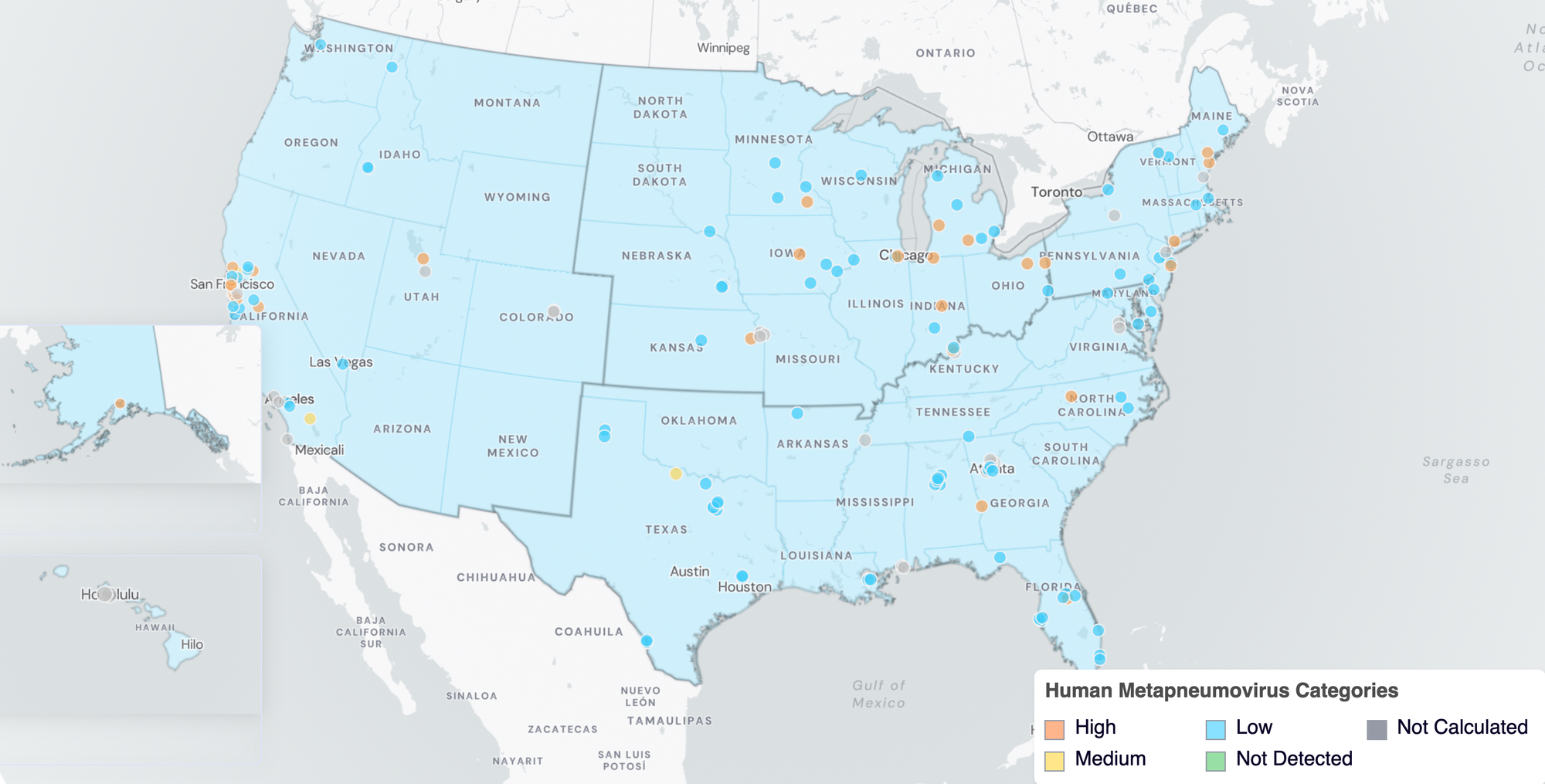
HMPV Wastewater Categories. This map includes sample collection data through December 31, 2025. Each dot represents a single site and the four US Census regions are outlined in gray. Midwest Region includes: IA, IL, IN, KS, MI, MN, NE, OH, SD, WI. Northeast Region includes: CT, MA, ME, NH, NJ, NY, PA, VT. Southern Region includes: AL, AR, DE, FL, GA, KY, LA, MD, MS, NC, TN, TX, VA, and WV. Western Region includes: AK, CA, CO, HI, ID, NV, UT, WA.
Enterovirus D68 (EV-D68) RNA was detected in ~28% of samples collected in December 2025 (with most positive detections in California). The median concentration across all sites in December 2025 was below the limit of detection.
Below is the population-weighted average EV-D68 RNA(normalized by PMMoV) shown in black from all participating WWSCAN sites across the country over the last 24 months. In this plot you can see elevated EV-D68 concentrations in the Midwest (shown in red) which began in mid August 2025 before coming down in November 2025, and increasing concentrations in the West (shown in blue) which began in late September 2025.
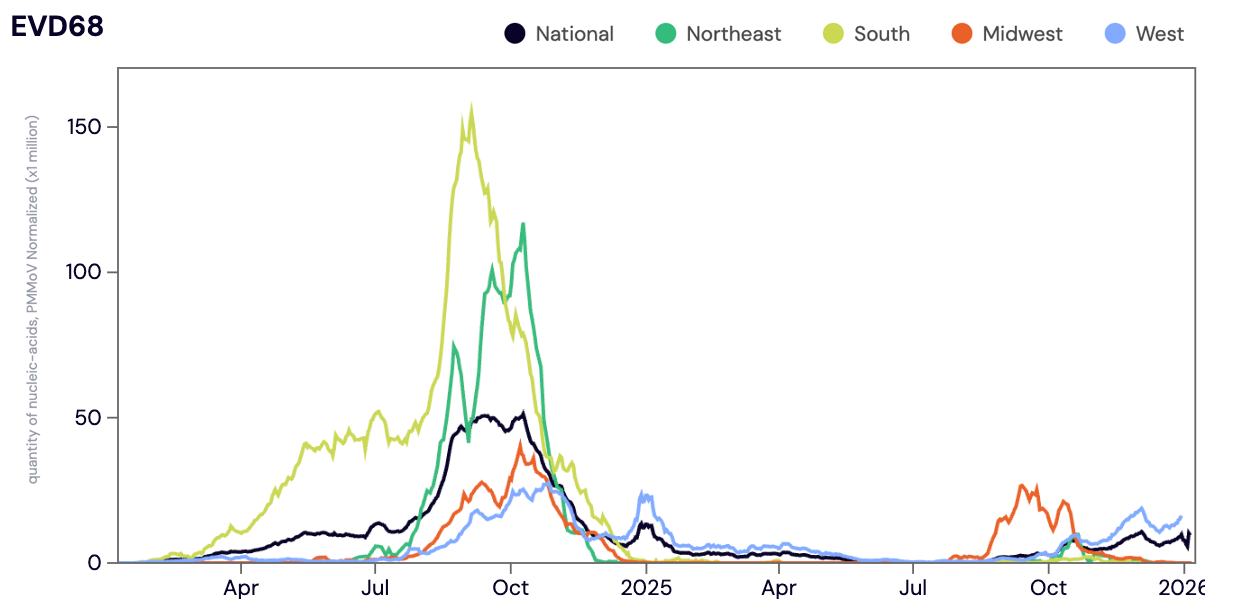
Midwest states: IA, IL, IN, KS, MI, MN, NE, OH, SD, WI. Northeast states: CT, MA, ME, NH, NJ, NY, PA, VT. Southern states: AL, AR, DE, FL, GA, KY, LA, MD, MS, NC, TN, TX, VA, and WV. Western States: AK, CA, CO, HI, ID, NV, UT, WA.
Nationally, EV-D68 is in the 'LOW' Wastewater Category with >50% of sites in offset of EV-D68 in wastewater. However the West is in the 'HIGH' category due to >50% of sites in onset, all of which are in California.
Below are the current EV-D68 wastewater categories for all WWSCAN sites (recall the category is determined by both the trend and the level):
- 99 are in the LOW Wastewater Category
- 0 are in the MEDIUM Wastewater Category
- 22 are in the HIGH Wastewater Category
- 26 do not have enough data to calculate
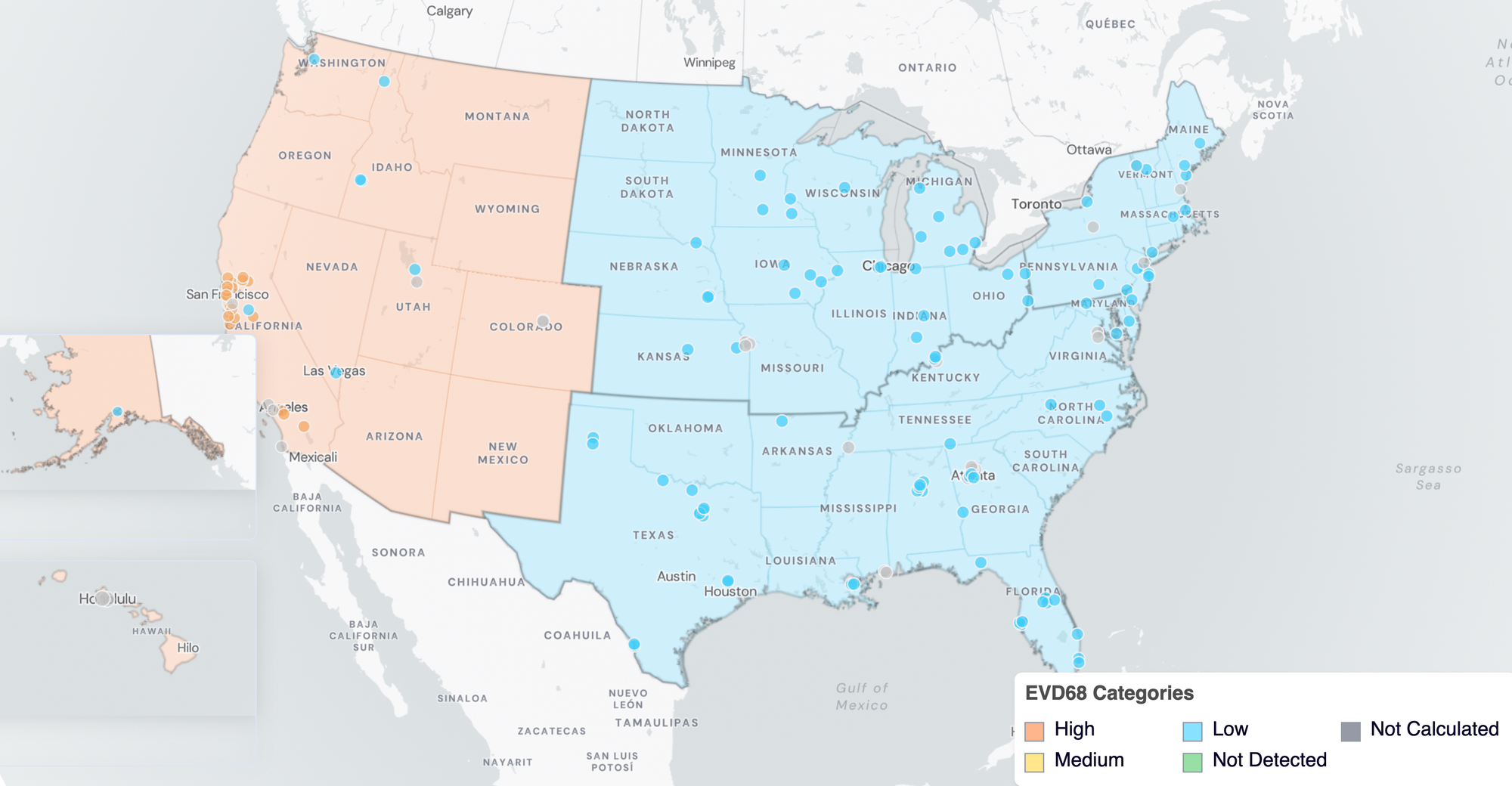
EV-D68 Wastewater Categories. This map includes sample collection data through December 31, 2025. Each dot represents a single site and the four US Census regions are outlined in gray. Midwest Region includes: IA, IL, IN, KS, MI, MN, NE, OH, SD, WI. Northeast Region includes: CT, MA, ME, NH, NJ, NY, PA, VT. Southern Region includes: AL, AR, DE, FL, GA, KY, LA, MD, MS, NC, TN, TX, VA, and WV. Western Region includes: AK, CA, CO, HI, ID, NV, UT, WA.
Parvovirus (Parvo) DNA - In mid May 2025, WWSCAN began prospectively monitoring for Parvovirus. Parvovirus B19 DNA was detected in ~27% of samples collected in December 2025 across WWSCAN sites.
The chart below shows each WWSCAN plant across the San Francisco Bay Area as rows, and days as columns (labeled at the bottom axis). White indicates no samples, blue is a non-detect for Parvo DNA and red is a detection for Parvo DNA.
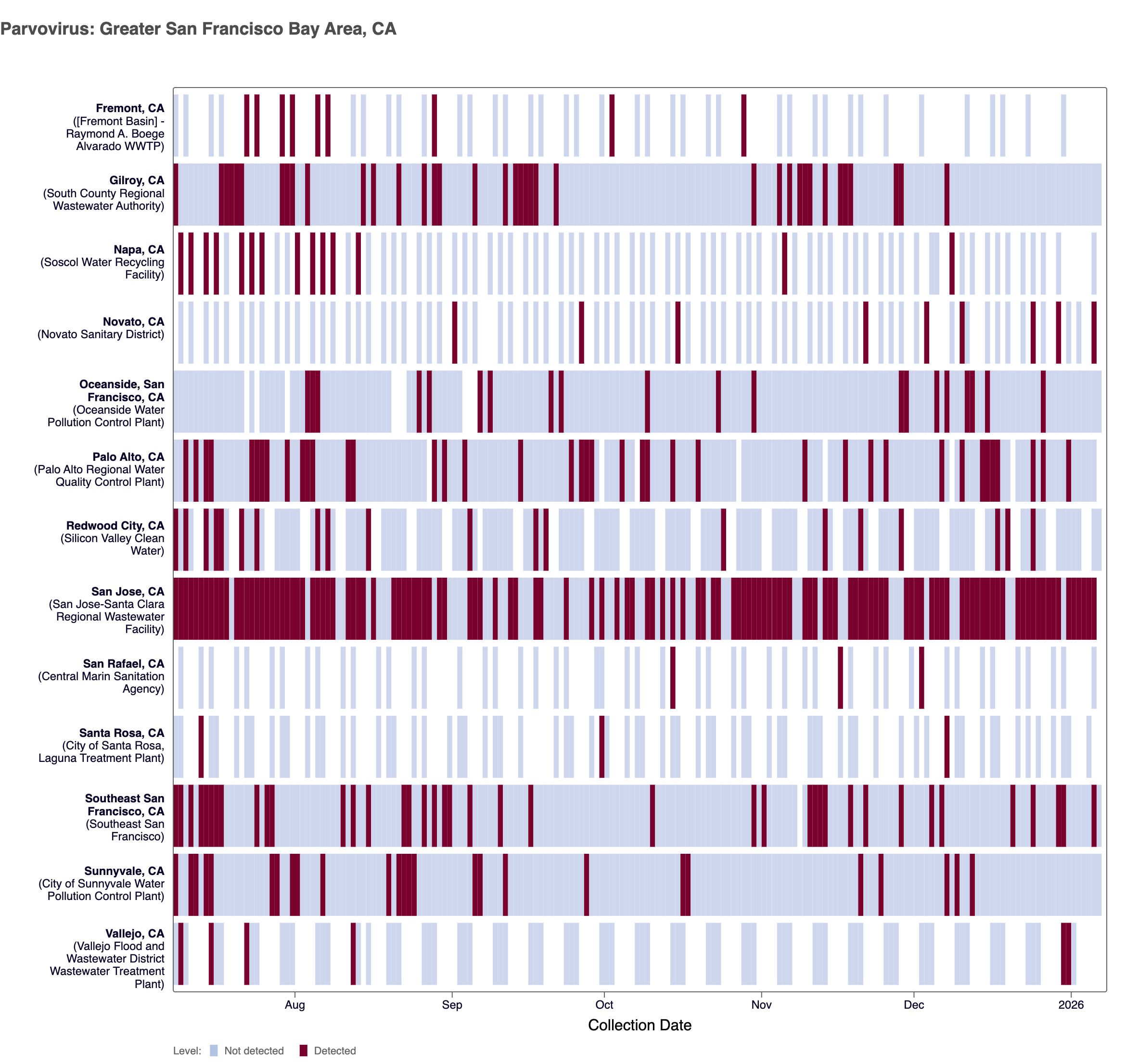
As a reminder, we are not currently calculating wastewater categories for Parvovirus. In order to calculate wastewater categories we need a longer time series of data to examine trends and levels.
We published a paper on 'Community Infections Linked with Parvovirus B19 Genomic DNA in Wastewater, Texas, USA, 2023–2024'. This paper covers retrospective analysis conducted at two WWTPs in Texas prior to WWSCAN rolling out the assay to all participating WWSCAN sites. You can find the paper linked here.
Gastrointestinal Pathogens
Norovirus GII, Human Adenovirus Group F, & Rotavirus
Norovirus GII (HuNoV GII) RNA was detected in 100% of samples analyzed in December 2025. The median Norovirus concentration in December 2025 was up ~71% compared to November 2025. Last year, we saw Norovirus concentrations start to increase in early October 2024 and peak early February 2025. While we are seeing a slower start to the winter Norovirus wave this year (2025-2026), but concentrations are continuing to increase.
Below is the population weighted average HuNoV GII RNA concentrations (normalized by PMMoV) shown in black from all participating WWSCAN sites across the country over the last 24 months.
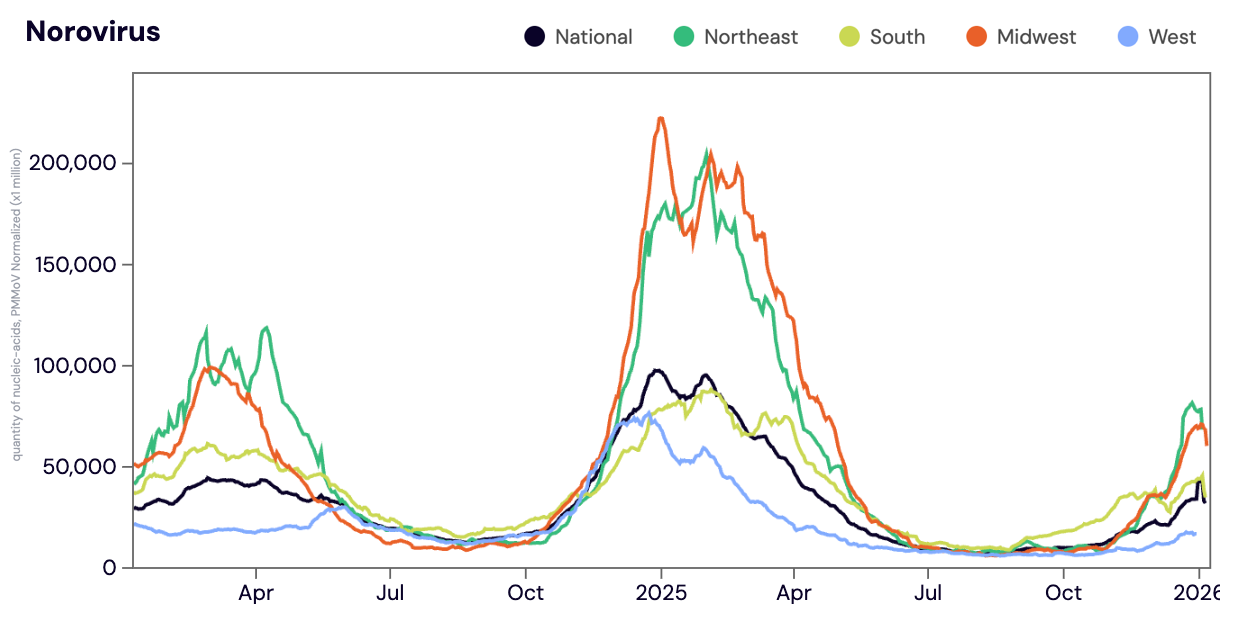
Midwest states: IA, IL, IN, KS, MI, MN, NE, OH, SD, WI. Northeast states: CT, MA, ME, NH, NJ, NY, PA, VT. Southern states: AL, AR, DE, FL, GA, KY, LA, MD, MS, NC, TN, TX, VA, and WV. Western States: AK, CA, CO, HI, ID, NV, UT, WA.
Nationally, Norovirus is in the 'HIGH' Wastewater Category with aggregated measurements showing high concentrations and an upward trend. Most regions are in the 'HIGH' wastewater category but the West is in the 'MEDIUM' wastewater category.
Below are the current Norovirus wastewater categories for all WWSCAN sites (recall the category is determined by both the trend and the level):
- 12 are in the LOW Wastewater Category
- 37 are in the MEDIUM Wastewater Category
- 72 are in the HIGH Wastewater Category
- 26 do not have enough data to calculate
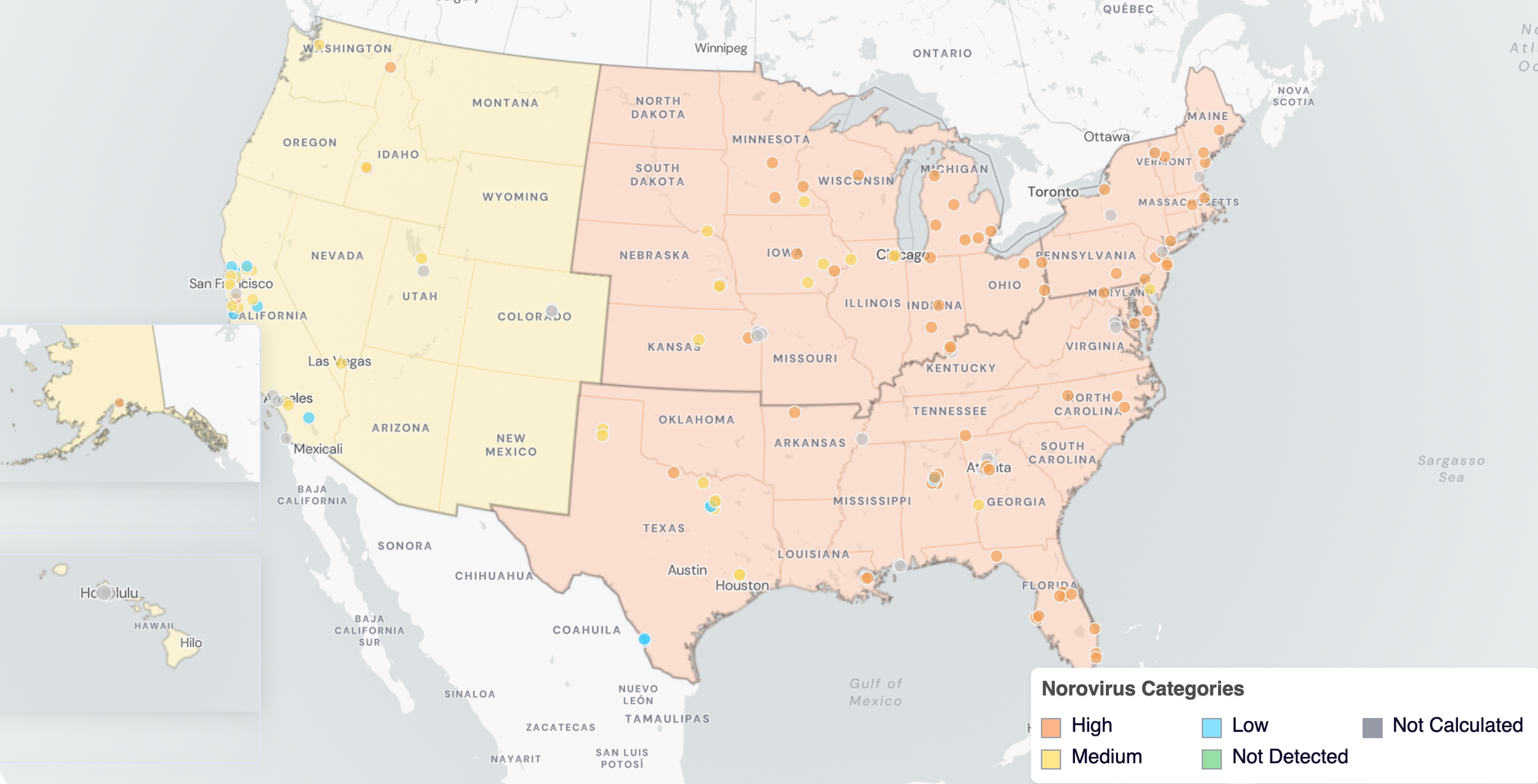
Norovirus Wastewater Categories. This map includes sample collection data through December 31, 2025. Each dot represents a single site and the four US Census regions are outlined in gray. Midwest Region includes: IA, IL, IN, KS, MI, MN, NE, OH, SD, WI. Northeast Region includes: CT, MA, ME, NH, NJ, NY, PA, VT. Southern Region includes: AL, AR, DE, FL, GA, KY, LA, MD, MS, NC, TN, TX, VA, and WV. Western Region includes: AK, CA, CO, HI, ID, NV, UT, WA.
Human Adenovirus Group F (HAdV-F) RNA - In mid May 2025, WWSCAN began prospectively monitoring for HAdV-F.
HAdV-F RNA was detected in 100% of samples from all WWSCAN sites in December 2025. The median concentrations across all sites in December 2025 was is 5,353,232 copies/gram, up ~2% from November 2025.
As a reminder, we are not currently calculating wastewater categories for HAdV-F. In order to calculate wastewater categories we need a longer time series of data to examine trends and levels.
Rotavirus (Rota) RNA- In mid May 2025, we started measuring Rotavirus again. We previously paused measurements of Rota in December 2024 in order to being measuring Mpox clade Ib.
Rota RNA was detected in ~93% of samples from all WWSCAN sites in December 2025. The median concentrations across all sites in December 2025 was 26,794 copies/gram, up ~49% from November 2025.
Below is the is the population weighted average Rota RNA concentrations (normalized by PMMoV) shown in black from all participating WWSCAN sites across the country over the last 24 months. The dashed black lines indicate the period of time the Rota assay was paused (~6 months).
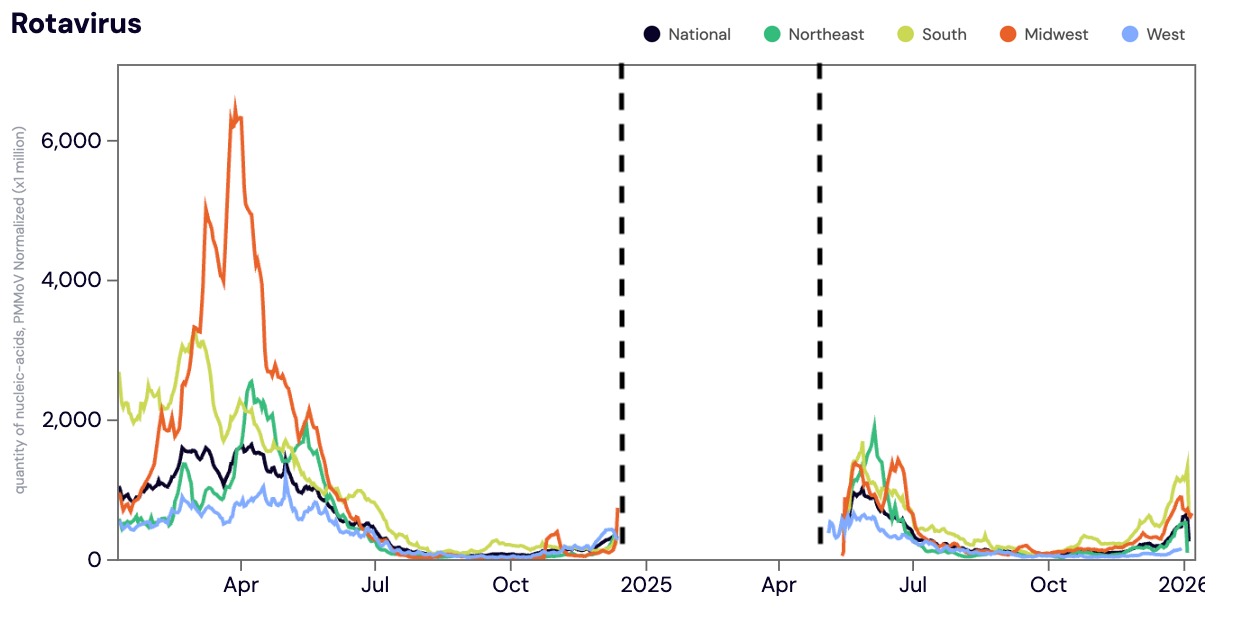
The dashed black lines indicate the period of time the Rota assay was paused (~6 months).
As a reminder, we are not currently calculating wastewater categories for Rota. In order to calculate wastewater categories we need a longer time series of data to examine trends and levels.
Other Pathogens of Concern
Candida auris, Hepatitis A, Measles, Mpox clade Ib, Mpox clade II, and West Nile Virus
Candida auris (C.auris) DNA - We detected C. auris DNA in ~4.2% of samples from all WWSCAN sites in December 2025. Nationally, C. auris is in the 'LOW' category due to limited detections.
The chart below shows plants in HHS Region 5 (Midwest) as rows, and days as columns (labeled at the bottom axis). White indicates no samples, blue is non-detect for C. auris DNA and red is detect for C. auris DNA.
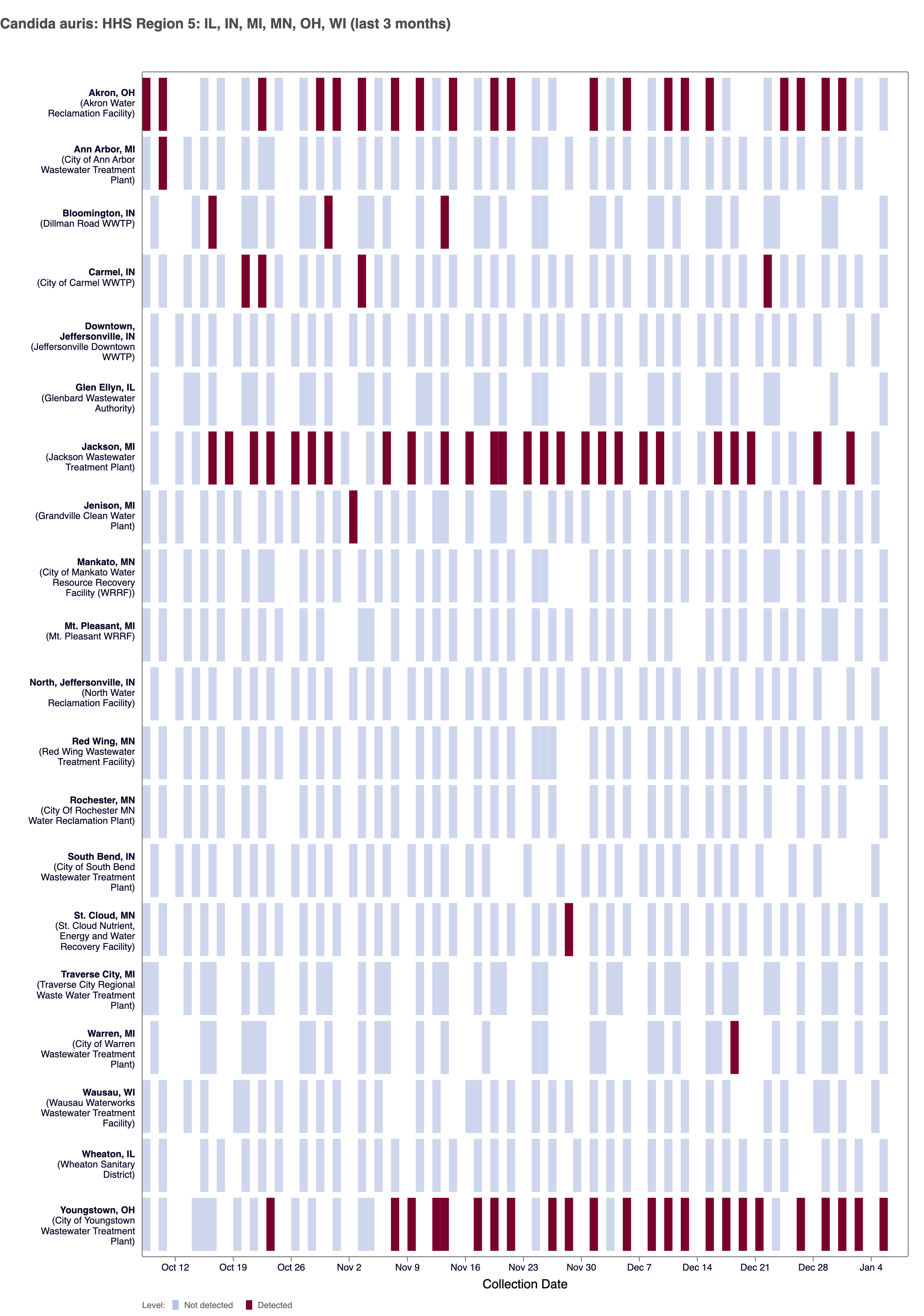
Below are the C. auris wastewater categories for all WWSCAN sites (recall the category is determined by the frequency of detection):
- 113 are in the NOT-DETECTED Wastewater Category
- 5 are in the LOW Wastewater Category
- 3 are in the MEDIUM Wastewater Category
- 0 are in the HIGH Wastewater Category
- 26 do not have enough data to calculate
Hepatitis A (Hep A) RNA - We detected Hep A RNA in ~11% of samples from all WWSCAN sites in December 2025. Nationally, HepA is in 'LOW' category due to limited detections.
The chart below shows each WWSCAN plant in Florida as rows, and days as columns (labeled at the bottom axis). White indicates no samples, blue is a non-detect for Hep A RNA and red is a detection for Hep A RNA.
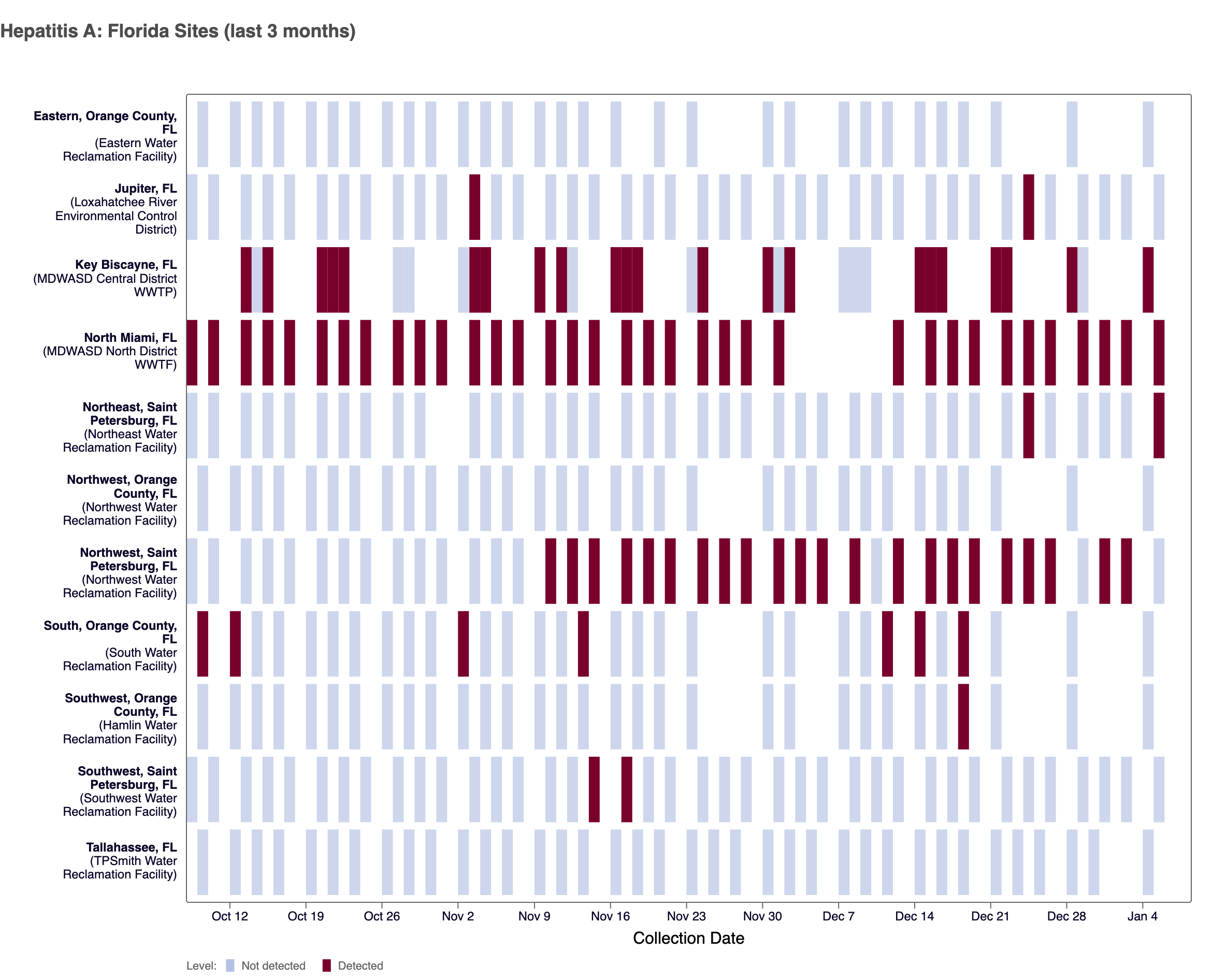
Below are the current HepA wastewater categories for all WWSCAN sites (the category is determined by the frequency of detection):
- 83 are in the NOT-DETECTED Wastewater Category
- 21 are in the LOW Wastewater Category
- 17 are in the MEDIUM Wastewater Category
- 0 are in the HIGH Wastewater Category
- 26 do not have enough data to calculate
Measles (MeV) RNA - In mid-May 2025, WWSCAN began prospectively monitoring for MeV. In December 2025, there were 11 positive detections of MeV in wastewater samples (3 in CA and 8 in UT). Nationally, MeV is in the 'LOW' category due to limited detections.
Since monitoring began, 26 sites across 17 states (AK, CA, CO, CT, FL, GA, IA, ID, IL, IN, KS, MD, MI, MN, NV, NY, UT) have had at least 1 positive detection of MeV in wastewater samples collected. Below is a map of sites with MeV detections in wastewater since prospective monitoring began.
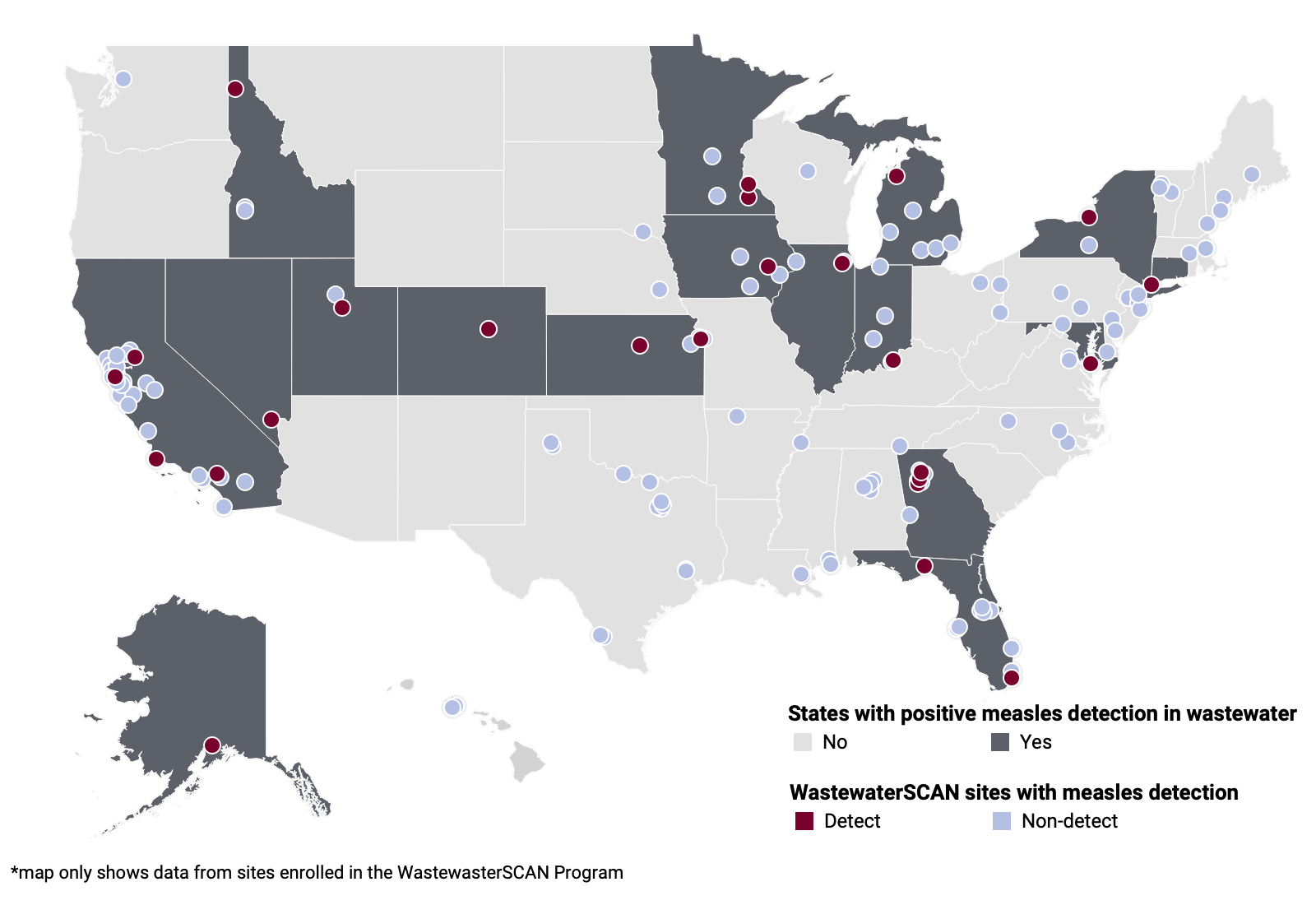
Below are the current MeV wastewater categories for all WWSCAN sites (the category is determined by the frequency of detection):
- 119 are in the NOT-DETECTED Wastewater Category
- 2 are in the LOW Wastewater Category
- 0 are in the MEDIUM Wastewater Category
- 0 are in the HIGH Wastewater Category
- 26 do not have enough data to calculate
Mpox clade Ib DNA - In mid December 2024, WWSCAN began prospective monitoring for Mpox clade Ib. You can find a heat map of the Mpox clade Ib data here. In December 2025, there were no positive detections of Mpox clade Ib. Nationally, Mpox clade Ib is in the 'NOT-DETECTED' category due to no recent detections.
Below are the Mpox clade Ib wastewater categories for all WWSCAN sites (recall the category is determined by the frequency of detection):
- 121 are in the NOT-DETECTED Wastewater Category
- 0 are in the LOW Wastewater Category
- 0 are in the MEDIUM Wastewater Category
- 0 are in the HIGH Wastewater Category
- 26 do not have enough data to calculate
Mpox clade II DNA - There were 12 positive detection of Mpox clade II in December 2025 (1 in AL, 8 in CA, 1 in LA, and 2 in UT). Nationally, Mpox clade II is in 'LOW' category due to limited detections.
Below are the Mpox clade II wastewater categories for all WWSCAN sites (recall the category is determined by the frequency of detection):
- 116 are in the NOT-DETECTED Wastewater Category
- 5 are in the LOW Wastewater Category
- 0 are in the MEDIUM Wastewater Category
- 0 are in the HIGH Wastewater Category
- 26 do not have enough data to calculate
West Nile Virus RNA - In mid October 2025, WWSCAN began prospective monitoring for West Nile Virus (WNV). There was 1 positive detection of WNV in December 2025 (1 in IA) Nationally, WNV in the 'NOT-DETECTED' category due to no recent detections.
Below are the WNV wastewater categories for all WWSCAN sites (recall the category is determined by the frequency of detection):
- 121 are in the NOT-DETECTED Wastewater Category
- 0 are in the LOW Wastewater Category
- 0 are in the MEDIUM Wastewater Category
- 0 are in the HIGH Wastewater Category
- 26 do not have enough data to calculate
WWSCAN protocols and methods
Protocols (Pre-analytical methods and SARS-CoV-2 analytical methods including controls):
- High Throughput RNA Extraction and PCR Inhibitor Removal of Settled Solids for Wastewater Surveillance of SARS-CoV-2 RNA
- High Throughput pre-analytical processing of wastewater settled solids for SARS-CoV-2 RNA analyses
- Quantification of SARS-CoV-2 variant mutations (HV69-70, E484K/N501Y, del156-157/R158G, del143-145, LPPA24S, S:477-505, and ORF1a Del 141-143) in settled solids using digital RT-PCR
- High Throughput SARS-COV-2, PMMoV, and BCoV quantification in settled solids using digital RT-PCR
- High Throughput wild type measles quantification in settled solids using digital RT-PCR
Pre-prints and peer-reviewed publications provided WWSCAN methods:
- SARS-CoV-2
- Influenza, Human metapneumovirus, Respiratory syncytial virus, Human parainfluenza
- Mpox clade Ib
- Mpox clade II
- Norovirus GII
- Adenovirus group F, Rotavirus
- Candida auris
- Hepatitis A
- Enterovirus D68
- Parovirus
Join us at the next WWSCAN Stakeholder call on January 9, 2025
If you have questions about the website or anything else, please email: wwscan_stanford_emory@lists.stanford.edu